
Two ice cream brands just delivered one of the most expensive trademark lessons of the year, and it has nothing to do with a name or a logo.
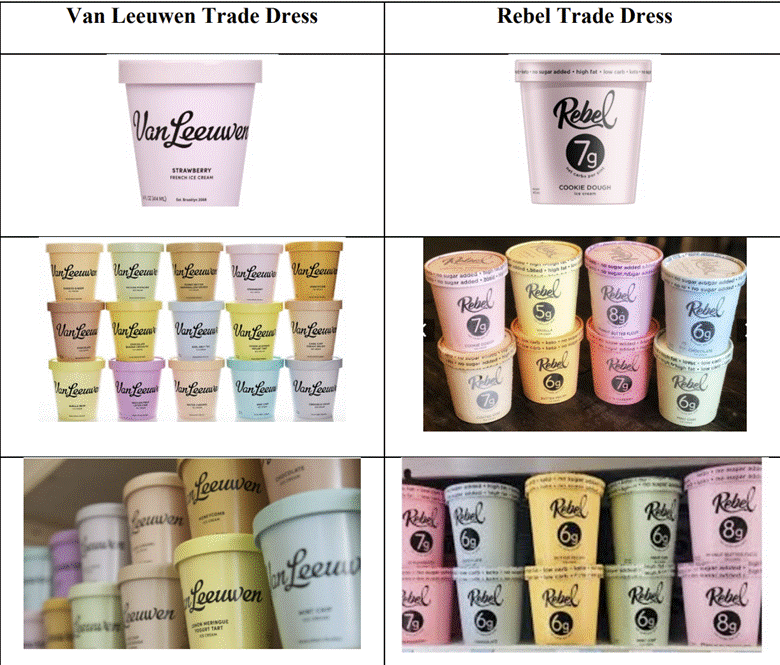
From the Complaint https://storage.courtlistener.com/recap/gov.uscourts.nyed.463399/gov.uscourts.nyed.463399.1.0.pdf
In July, a federal judge here in Brooklyn ordered Rebel Creamery, the keto ice cream sold at Walmart and Kroger, to hand over $23.8 million in profits and redesign its packaging. The reason: Its pints looked too much like Van Leeuwen’s. Monochrome pastel cartons, matching lids, black cursive script with an oversized first letter, minimalist layout. Rebel never used the Van Leeuwen name. It didn’t have to. A month after the ruling, Rebel filed for Chapter 11 while it appeals.
That is trade dress, and if your product has a recognizable look, this case is worth ten minutes of your attention.
What Trade Dress Actually Protects
Trade dress is the overall visual impression of a product or its packaging: colors, shapes, fonts, layout, the combination that makes a customer reach for your product from across the aisle. It’s protectable under the same law as trademarks, because it does the same job: It tells consumers who made the thing.
Three details from this case matter more than the dollar figure.
- The trade dress was never registered. Van Leeuwen won on an unregistered look. That’s possible, but it’s the hard way. You have to prove the look has acquired meaning in consumers’ minds, and it took a full bench trial to get there. A registration would have put that presumption on the certificate.
- “Every element is common” didn’t work as a defense. Rebel argued that pastel colors and minimalist design are everywhere in the food aisle. The court agreed that no single element was unique and found infringement anyway. Trade dress is judged on the whole combination and the impression it creates, not piece by piece.
- Waiting nearly cost them the case. A Van Leeuwen employee reportedly spotted Rebel’s packaging in late 2018. The lawsuit wasn’t filed until 2021. In the meantime, Rebel grew into national retail. When the copier gets bigger than the original, you’re fighting reverse confusion, where customers start assuming you’re the knockoff. Van Leeuwen still won, but the delay made it harder and more expensive.
The “Dupe” Problem
Dupes are marketed openly now. Entire social media accounts are devoted to “the same thing for a third of the price.” Some of that is fair competition. Nobody owns pastel. But the line is confusion: If a shopper could grab the dupe thinking it’s yours, or assume the two brands are related, the dupe maker has a problem, and this case shows how large that problem can get. Intentional copying also changed the math here. Once the court found Rebel copied on purpose, it awarded profits.
What to Do If Your Product Has a Look
- Document the design. Keep dated photos of every packaging iteration, the design brief, and the rationale. Proof of when you adopted the look is your foundation.
- Collect evidence of recognition. Press mentions, customer comments, sales figures, ad spend. This is what turns “nice packaging” into protectable trade dress.
- Register when you can. Once the look has recognition, it’s worth pursuing a trade dress registration. It shifts the burden in any future fight.
- Send the letter early. A cease-and-desist while the copier is small preserves your options and limits the damage. Waiting until they’re in Walmart is a much bigger fight.
- Check your own shelf. If you’ve been “inspired” by a category leader, take an honest look before they do.
Trade dress is the part of your brand most owners never think about until someone copies it. If your product has a look customers know on sight, let’s make sure you own it. Call us today at (888) 666-0062 or click here to schedule your initial Discovery and Strategy Session online.
DISCLAIMER: The information contained in this article is for informational purposes only and is not legal advice or a substitute for obtaining legal advice from an attorney.